A fill house that had already been burned
Model in this case: D135 — 3.5 ml / 5 ml capacity, 350 mAh, smart screen; three-step voltage is available on this build.
A US fill house that fills and labels for several CBD brands came to us with a problem they had already lived through. Their distillate is very thick. Suppliers using a conventional single-bore ceramic core had left them with two outcomes they would not accept again: cores that clogged under that viscosity, and oil that escaped the reservoir and reached the device body.
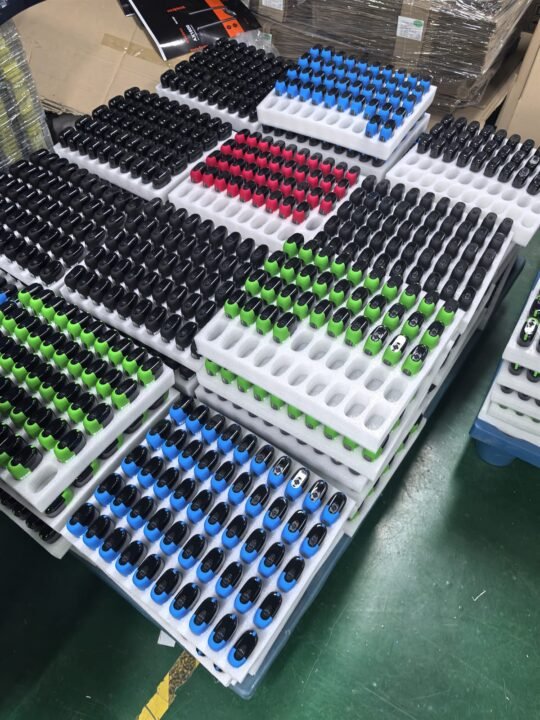
So they arrived with one requirement ahead of everything else: the oil has to stay where it belongs.
What we did
- We sent samples at our standard parameters first, so they were looking at a baseline rather than a promise.
- From there we ran a parameter programme with them. Three-step voltage is available on many of our models — which ones, and how the steps are set, depends on the model they pick, and we worked through voltage, draw and wicking against their own oil.
- This was not a one-shot sample: it took several rounds of their test feedback before they would commit.
Where it landed
The engineering lesson we kept
Oil containment is a design requirement, not a feature. In our ceramic builds the heating element sits inside the ceramic body, isolated from the reservoir, so the oil has a defined path and the device body is not part of it. That is the part we control as the hardware supplier; the formulation stays with the customer.
A brand that found us through another brand’s D064 device
Model in this case: D064 — 1 / 2 / 4 / 5 ml capacity options, 280 mAh, ceramic core, preheat.
A US brand owner came to us in an unusual way: they were already buying a device from another brand, liked how it worked with their formulation, and traced the hardware back to us.
Their oil contains terpenes, and they were not sure any hardware supplier could work around that. Our answer was plain: as long as the oil is not as thin as an e-liquid and not a paste, we can test it and tune parameters to it. No promises about a formulation we have not seen — a test first.
One honest limit, and why it matters to you
We cannot legally test with controlled cannabinoid formulations inside China. So our in-house work runs on pure VG, and the customer validates their own formulation on the samples we send.
That limit is exactly why the samples we ship come from a model that has already been qualified on our side, once per model rather than once per order: in-house bench validation on pure VG in China, then 100 units through a US third-party laboratory, 200 units through partner-brand real-oil testing and 500 units through channel trial sales. You are testing your oil against hardware we have already qualified — not acting as our test lab, and not paying for a test programme on every order.
What we did
- They accepted a sample test.
- We adjusted voltage and resistance against their feedback — several rounds of it.
- The specification was frozen only when their own testing agreed.
Where it landed
Volumes grew from there, and they have kept ordering.
What it changed for them
A stable device they can build a brand on. When a formulation works in the hardware, the brand spends its money on marketing instead of re-testing hardware.