
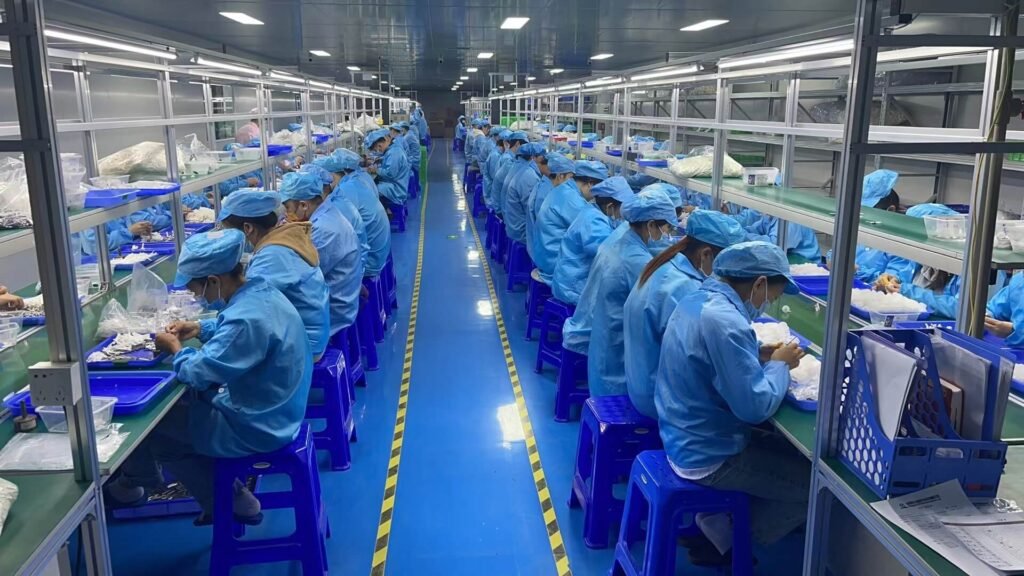
Most buyers searching for a china vape factory online are met with thousands of nearly identical listings. Every company claims to have the best quality, the lowest prices, and the fastest shipping. However, the reality of the Shenzhen supply chain is that many “manufacturers” are actually small trading companies operating out of a shared office. For a CBD brand, choosing the wrong partner can lead to leaking hardware, clogged coils, or seized shipments. Conducting a thorough shenzhen vape manufacturer audit is the only way to ensure your hardware is produced in a controlled environment by people who understand the technical requirements of thick oil.
The Live Video Audit: Seeing the Floor in Real-Time
The easiest way to verify a supplier is to ask for a live video call via Zoom or WhatsApp. Do not rely on pre-recorded marketing videos or professional photography found on a website. These are often bought from third-party studios or even “borrowed” from other factories. A real manufacturer will have no problem walking onto the production floor and showing you the assembly lines, the testing equipment, and the warehouse.
When we conduct these calls for potential clients, we show the actual workers assembling components and the QC stations where pens are checked for airflow and battery voltage. If a supplier makes excuses, such as “the factory is in a different city” or “video calls are not allowed for security reasons,” they are likely a middleman. A middleman adds cost and creates a communication gap that often leads to errors in custom branding or technical specifications. You can see what that looks like on the production line used for Pulse-managed projects in Inside the Factory — the quality-control station, the packing line, and packing data from a real shipment.
During the video call, look for specific details. Are the workers wearing anti-static clothing and hairnets? Is the floor clean? Are there clear labels on the bins of components? These small details tell you a lot about day-to-day management — but they are not a substitute for the documents covered below. You can even reach us at WhatsApp +86 139 2466 6401 to schedule a live walkthrough of our facilities to see how we handle production.
Verifying Physical Locations: Office vs. Factory
In the Shenzhen vape industry, it is common for a company to have a separate office for sales and a factory for production. You must verify both to understand the scale of the operation. ShenZhen Pulse Technology Co., LTD was founded in 2020, but our core team has 10+ years in the CBD vaporizer industry. This experience has taught us that transparency regarding our locations is vital for building trust with overseas distributors.
Our office is located at 2705, Block E, Building 1, Vanke Xingcheng Huafu, Xinqiao Street, Bao’an District, Shenzhen, China. This is where our engineering and sales teams work on new product designs and client accounts. However, the actual manufacturing for Pulse-managed projects is carried out at our qualified manufacturing partner’s facility located at 4/F, Building B3, No.142 Liyuan Road, Fuyong, Bao’an District, Shenzhen, Guangdong, China, 518103. When you are performing an audit, ask the supplier for the specific addresses of both their sales office and their production facility. If the addresses match a residential apartment or a generic “business center” with no industrial zoning, they are not a true manufacturer.
Checking Business Licenses and Longevity
A reputable china vape factory should be able to provide a business license that matches their bank account name. Check the “Date of Incorporation.” While many new companies appear every year, look for a team with deep industry roots. Although Pulse was officially registered in 2020, our engineers have been working on ceramic coil technology since the early days of the industry. We have developed 20+ product models specifically for the CBD market. A factory with a long history is more likely to have stable relationships with raw material suppliers, which ensures consistent quality across different batches.
How to check a Shenzhen supplier in the official registries
A business-licence PDF proves very little. China publishes company registration data you can read yourself.
Step 1 — get the legal name and credit code. Ask for the legal name exactly as printed on the business licence, in Chinese characters, plus the 18-digit Unified Social Credit Code.
Look at: the same name on the licence, the invoice, and the receiving bank account.
Red flag: an English trading name only, or a name that changes between documents.
Step 2 — search the national register. Open the National Enterprise Credit Information Publicity System at gsxt.gov.cn and enter that name or code.
Look at: status (存续 or 在业 means active), the legal representative, the establishment date, the registered address, the business scope (经营范围), and abnormal-operation or serious-violation listing (经营异常名录 / 严重违法失信名单).
Red flags: a status of 注销 or 吊销 (deregistered or revoked); a registered address that is a flat, not a plant; a scope that does not cover your product.
Step 3 — cross-check in the Shenzhen register. Open the Shenzhen Administration for Market Regulation at amr.sz.gov.cn and look up the same credit code. Its licence and penalty publicity is at amr.sz.gov.cn/xxgk/qt/ztlm/zfgs.
Look at: the Shenzhen record for that credit code, its registered address, and any penalty.
Red flag: a different address, a scope that does not cover your product, or an unmentioned penalty.
Step 4 — request the filed registration archive. The Shenzhen enterprise registration archive is at pub.amr.sz.gov.cn/qydjdafwpt.
Look at: whether the archived record matches the summary from steps 2 and 3. Use this path, not the bare domain, which is an empty page.
Red flag: an archive that does not match, or an entity that cannot produce one.
Step 5 — confirm the licence category exists. Read the e-cigarette licensing rules on the State Administration for Market Regulation site at samr.gov.cn, including the question-and-answer page.
Look at: electronic-cigarette producers must hold a Tobacco Monopoly Production Enterprise Licence (烟草专卖生产企业许可证) under the tobacco-monopoly licensing system.
Red flag: a document whose title matches no published licence category.
What this proves, and what it does not. Registry data confirms that a legal entity exists, who its legal representative is, when and where it was registered, what its scope covers, and whether it is listed for abnormal operation or a serious violation. It does not tell you the size of the production floor, whether your order will run there, how the factory controls quality, or whether a certificate covers the site that will produce your batch. Use the registry as the first gate, and take the legal name it gives you into a live factory audit and a third-party pre-shipment inspection.
The Credentials Buyers Now Ask For
Factory-verification advice has shifted. Buyers used to compare impressions; today the first round is about hard documents. If you are running a structured audit on us, here is exactly what we hold, where it sits, and how to check it.
How Pulse is structured
Pulse (ShenZhen Pulse Technology Co., LTD) is the product design and commercial partner. We own the product design, our own tooling (private moulds), and the component supply chain — batteries, shells and other parts come from our own qualified suppliers, so our designs and tooling are ours alone.
Production is executed by our licensed manufacturing partners in Shenzhen (Fuyong, Bao’an District). Quality-management, cleanroom and material documentation — ISO 9001, ISO 13485 / GMP, RoHS / CE / FDA food-grade, heavy-metal screening — sits with the individual factories that hold it, and we pass on the copies they release for your file. The factories that build for us include the holder of a China Tobacco Monopoly Production Enterprise Licence (export scope), which formal export declaration requires.
We welcome third-party pre-shipment inspection (SGS, QIMA, V-Trust) and will provide our manufacturing partner’s licence and the relevant test reports for your verification on request. Every shipment moves through formal export customs declaration, which requires those licences and product documents to be in place — our manufacturing partners must cooperate with proper declaration for the order to proceed at all.
The document set to request
- China Tobacco Monopoly Production Enterprise Licence — held by the manufacturing partner that runs your order. Ask which entity will produce your batch, then check that name on the official registry.
- ISO 9001 and ISO 13485 / GMP cleanroom certification — issued to the same legal entity and the same production address.
- Heavy metals screening documentation — covering the oil-contact path (ceramic, metal, glass, silicone, adhesives), with reference to the limits applied under California and Michigan regulations.
- RoHS / CE / FDA food-grade material documentation — for gaskets and wicking materials.
- UN38.3 and MSDS — for the battery cells, required for air freight.
What we do not claim
Pulse does not hold a Tobacco Monopoly Production Enterprise Licence in its own company name — production is licensed at our partner factories, which is why we tell you to verify the producing entity rather than us. We say this plainly because you are going to check, and because a supplier that overstates its credentials is a supplier you cannot audit.
Evaluating the Three-Stage Quality Control Process
Quality control is where most cheap factories cut corners to save money. When you audit a manufacturer, ask them to explain their QC process in detail. At Pulse, we use a rigorous three-stage quality check to ensure our hardware performs reliably in the field. This process is designed to catch issues before the bulk of the order ever leaves the factory floor.
- Stage 1: US Lab Testing. We send the first 100 units of a new model — before it is offered to any customer — to a partner lab in the US. This ensures the hardware meets the specific requirements of the US market and functions as intended with standard industry oils.
- Stage 2: Partner Brand Testing. We then send the next 200 units to our long-term partner brands. These are real-world users who provide feedback on the “hand-feel,” draw resistance, and overall reliability of the hardware.
- Stage 3: Channel Trial Sales. Finally, we move 500 units through channel trial sales. This allows us to monitor for any rare defects or shipping-related issues before the full production batch is finalized.
If a factory tells you they “check everything” but cannot explain their specific testing steps, they likely only do a basic battery light test. For CBD brands, this is not enough. Our hardware is designed for thick CBD distillate-style oils and is not suited to nicotine e-liquids. Because CBD oil is much more viscous than nicotine liquid, the hardware requires precise heating temperatures and specific intake hole sizes to prevent clogging. We focus on hardware only – we do not supply or fill oil, which allows us to dedicate 100% of our QC resources to the mechanics of the vape pen itself.
Understanding Hardware Specialization
A major red flag during a shenzhen vape manufacturer audit is a factory that claims to do everything. If they sell nicotine disposables, CBD pens, large mod kits, and e-liquids all in one place, they are likely a generalist. CBD hardware requires a different engineering approach than nicotine hardware. The ceramic formulas and the internal airway design must be optimized for the unique properties of hemp-derived distillates.
When you work with a specialized manufacturer, you get hardware that is built for your specific product. We have seen many brands fail because they tried to use standard nicotine hardware for thick CBD oil, resulting in burnt coils and wasted product. By focusing on empty hardware only, we ensure that our 20+ models are tested specifically for the viscosity of CBD oils. This specialization is what you should look for when choosing a partner for your CBD vapes solution.
Logistics and US-Based Support
Verification doesn’t stop at the factory gates; you also need to know how the supplier handles international logistics. Many Chinese factories will ship your order and then disappear if there is a problem with customs or a defect in the batch. A reliable factory will have a footprint in your target market to provide better support.
We work with a partner lab and warehouse in the US. This is a significant advantage for our clients because sample units of our main models are stocked at a partner warehouse in the US, so trial orders reach US buyers faster. If you are a US-based brand, having a local point of contact for testing and sample orders can save you weeks of downtime. During your audit, ask the supplier if they have any US-based partners or if they provide any support once the goods leave China. If the answer is no, you are taking a much higher risk with your supply chain.
Standard Business Terms and Transparency
An honest factory salesperson will be very clear about their business terms from the start. If the terms keep changing or seem too good to be true, proceed with caution. At Pulse, we maintain a standard set of terms for all our B2B clients to ensure there are no surprises during the production cycle.
- Minimum Order Quantity (MOQ): 3,000 pcs for the first order. This allows us to set up the production line efficiently while giving new brands a manageable entry point.
- Payment Terms: 30% T/T deposit to start production, and the remaining 70% before shipment. This is the industry standard for legitimate factories in Shenzhen.
- Lead Time: Our standard lead time is 20-25 days. Anyone promising 5-day lead times for custom hardware is likely selling you old stock or skipping QC steps.
- Price Term: All prices are quoted as EXW Shenzhen.
Transparency in pricing and lead times is a hallmark of a professional CBD vape pen manufacturer. We do not hide costs, and we do not make promises we cannot keep. When we run a batch, we provide updates so you know exactly where your hardware is in the production timeline.
Finalizing Your Manufacturer Audit
Before you place an order, review the technical specifications of the hardware one last time. Ensure the factory understands that your oil is a thick distillate. Many factories will try to push “all-purpose” hardware, but in our experience, the best results come from hardware tuned to the oil’s specific density. If you are looking for more information on the differences between manufacturing styles, you can read about OEM, ODM, or white label CBD vape hardware to see which path fits your brand best.
Remember that we provide empty vape hardware and coordinate production through qualified manufacturing partners, but the customer or their licensed partner is responsible for the oil and ensuring local compliance. Vape products sold in the US are subject to FDA regulation, and you should always confirm your legal position with your own counsel. Our role is to provide the most reliable, high-performing hardware possible so that your brand can succeed in a competitive market.
Verifying a factory takes time, but it is much cheaper than dealing with a failed product launch. If you follow these steps—live video calls, address verification, and a deep dive into QC processes—you will find a partner that helps your business grow. We invite you to put our team to the test.
If you are ready to discuss your project or need to see our technical specifications, please request pricing and samples through our quote form – we reply within one business day. You can find the form at https://pulsecig.com/get-a-quote/ and start your verification process today.