
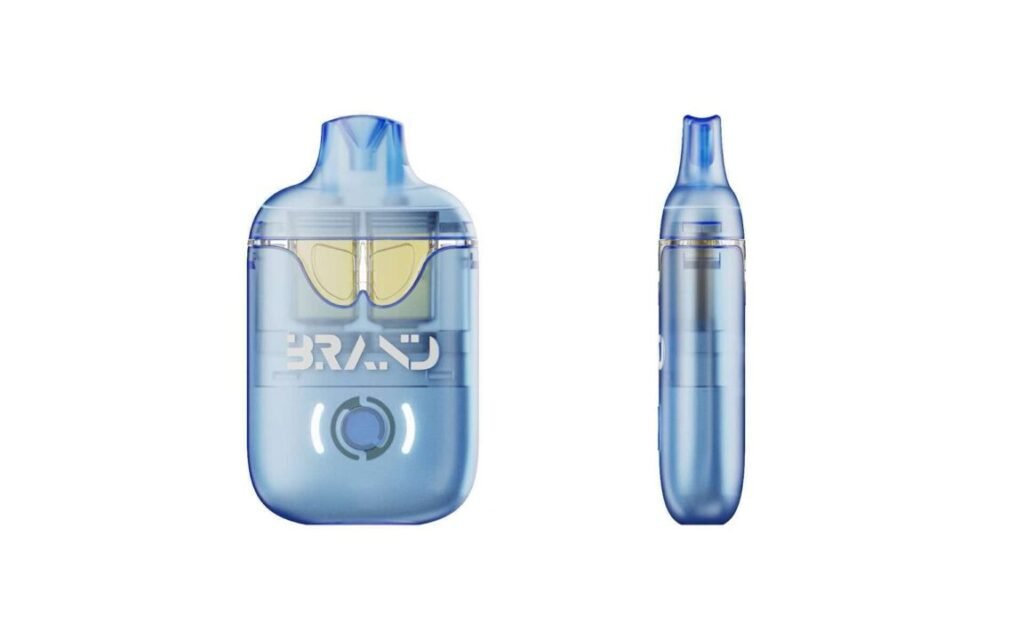
CBD distillate is thick. Most cartridge failures that reach a brand’s inbox — weak vapour, a burnt taste three days in, a pen that pulls like a blocked straw — trace back to one component: the core. This guide explains why ceramic cores clog, what separates a core that genuinely handles viscous oil from one that only handles thin e-liquid, and what to ask before you commit to a production run.
Why do ceramic cores clog in the first place?
Clogging is usually described as a “dirty oil” problem. In practice it is almost always a flow problem, and it shows up in three distinct ways:
- Feed starvation. Oil cannot reach the heating surface fast enough to replace what is vaporised. The core runs dry at the surface, the coil overheats the small amount of oil it can reach, and you get a burnt note long before the tank is empty.
- Airway restriction. Condensate and unvaporised oil collect in the vapour path. Over a few hundred puffs the draw tightens progressively. Users describe this as “the pen is clogged”, even though the core itself is fine.
- Residue build-up. On cotton wicks the fibre chars and collapses against the coil. Once that happens the restriction is permanent — the cartridge does not recover.
Each cause has a different fix, which is why “buy a better core” is only half the answer. You need a core with enough pore volume to feed thick oil, and an airflow path that gives condensate somewhere to go.
Why is thick CBD distillate harder on a cartridge than thin e-liquid?
Viscosity. CBD distillate at room temperature can be one to two orders of magnitude more viscous than the propylene glycol and vegetable glycerin blends a conventional vape cartridge is designed around. Those blends are thin and flow readily; distillate is closer to cold honey.
Getting oil to the heating surface depends on capillary action through the pores of the core. The narrower the pore and the thicker the oil, the slower the uptake. A cartridge that performs perfectly on a 70/30 PG/VG blend can starve continuously on distillate, because the core was specified for the wrong fluid. This is the single most common mismatch we see in incoming enquiries: a brand has tested its formulation in a thin e-liquid cartridge, then wonders why the same device behaves differently with oil.
Two practical consequences follow. First, pore size has to be matched to your formulation’s viscosity, not chosen from a generic catalogue. Second, the number of paths feeding the heating surface matters more as viscosity rises — if one channel is partially blocked by a bubble or a slug of cold oil, a single-intake core has nothing to fall back on.
What does a clog-resistant ceramic core actually look like?
Four structural features do most of the work. None of them is exotic; the difference is whether a supplier specifies them deliberately for viscous oil.
- No cotton wrap. Removing the cotton step removes a manual assembly operation — and manual operations are where unit-to-unit variation comes from. There is no fibre to char, collapse or filter the flavour, and the path the oil takes is the ceramic itself.
- Pore size sized for your formulation, not taken from a catalogue. Standard single-bore cores typically run in the region of 20-40 µm, which gives thick oil a usable uptake rate without turning the core into a sieve that leaks. Our own tri-channel core is specified at 8 µm instead, paired with the higher porosity described below — pore size and porosity are chosen as a pair, not one at a time.
- High porosity. Porosity is what holds oil in the structure and gives the heating surface its contact area: standard single-bore cores sit around 40-50%, and our tri-channel core runs at 55% ± 5.
- The element sits at a distance from the stored oil. In our tri-channel core the heating element — a nickel-chromium wire — runs through the central channel and the oil is drawn to it through the ceramic, so the tank is not sitting on the heat source. That keeps the bulk of the oil cooler between draws, and with distillate the aromatic fraction is the part heat affects first.
- More than one feed path. In our tri-channel core the feed runs through the ceramic body itself: a central vertical channel housing the heating element, with two side channels that carry oil and let pressure equalise. If one path is momentarily restricted, the others keep the core wet.
Cotton wick vs. ceramic core: which one clogs more with thick oil?
Structurally, a cotton-wrapped wick is the wrong tool for distillate, and a generic ceramic core is often only a partial improvement. Here is the comparison that matters for formulation decisions:
| Cotton-wrapped wick | Generic ceramic core | Cotton-free tri-channel ceramic | |
|---|---|---|---|
| Wicking material | Cotton, hand-fitted around the coil | Ceramic body around cotton, or copied single-channel geometry | Porous ceramic only, no fibre |
| Behaviour with thick distillate | Frequent starvation; cotton chars and collapses | Improved, but a single feed path still restricts flow | Multiple feed paths keep the heating surface wet |
| Flavour fidelity | Filtered by wick material | Partial filtering remains | Carries through the ceramic |
| Unit-to-unit consistency | Manual cotton step introduces variation | Varies by vendor and by batch | Automated core, no manual wicking step |
| Recovery after a dry puff | Usually permanent damage | Partial; depends on pore volume | Re-wets from the remaining feed paths |
Note what this table does not contain: measured performance numbers. We are describing structural differences, because a quantified comparison is only meaningful when it is produced by a bench test on a named formulation — and anyone quoting you a multiple without that test is guessing on your behalf. Ask for the test data instead.
Does a postless cartridge really resist clogging better?
A conventional cartridge routes vapour up through a central metal post from the core to the mouthpiece. That post is a long, narrow, cool surface, and cool surfaces are where unvaporised oil and condensate collect. Over time the accumulation narrows the airway, which is exactly the “progressive tightening” users report.
A postless design removes that central column. The vapour path from core to mouthpiece is shorter and has less internal surface area for oil to cling to. Paired with dual airflow, it also means the draw is fed from two directions rather than one, so a partial obstruction has less effect on the overall pull. Postless dual-airflow architecture is available on our D159 and D160 class disposables; if a supplier cannot tell you whether their cartridge has a central post, that alone tells you something about how well specified it is.
What voltage should you run on thick CBD distillate?
Thick oil generally wants a gentler, better-controlled power delivery than thin e-liquid, because the limiting factor is how fast the core can refill rather than how fast it can heat. Most ceramic-core CBD devices run in the region of 1.8-3.1 V, often with a preheat stage that warms the core briefly before the main draw so the first puff is not starved.
Within that window the right set point depends on your formulation and your cartridge geometry, so it should be treated as a specification to be set per project rather than a fixed number. We build to the voltage window our customers specify — one programme runs at 3.3 V — and we will tell you if a requested setting looks likely to starve the core rather than simply accepting the brief.
How do you test a core before committing to a 3,000-unit order?
Test with your own oil. A supplier’s demo cartridge, filled with the supplier’s own reference formulation, will not tell you how your distillate behaves — and the core is the component where that difference shows up first.
Ask for an unbadged sample and run it through the conditions your customers will actually create: cold-start draws, rapid consecutive puffs, a cartridge left standing for a week, and the lower end of your expected temperature range. Watch for flavour drift before you watch for total vapour output; the taste changes before the cloud does.
Sampling timelines at Pulse are short by design: blank and white-label units ship in 2-3 days to your nominated forwarder, standard samples in 2-8 days, and samples with paid logo printing in 5-7 days. That lets you run a real comparison against a conventional core before you make a production commitment.
What should you ask a supplier before you buy?
A short list, in the order that the answers usually matter:
- Is the core cotton-free? If the answer is vague, ask for the wicking construction — how the core moves oil to the heating surface — in writing.
- What is the specified pore size and porosity? A supplier who builds for distillate will have these numbers. A supplier who resells generic cartridges usually will not.
- How many intake paths feed the heating surface?
- Is there a central post, or is the design postless?
- What voltage window does the core tolerate, and is it customisable?
- Is the core platform properly licensed, or is it a copy? This matters commercially as well as legally — a copied core has no engineering owner to fix it when your formulation does not behave.
- Will you send an unbadged sample?
- MOQ, lead time and payment terms in writing.
Where a hardware supplier fits into this
Everything above concerns the device, not the oil. That boundary is deliberate on our side: Pulse manufactures empty CBD vape hardware only and does not supply, fill or sell oil, which keeps formulation compliance squarely with the brand that owns the product. Our hardware is designed for thick CBD distillate-style oils and is not suited to nicotine e-liquids.
Our standard terms are MOQ 3,000 pieces per model, production lead time of 20-25 days after deposit confirmation, and EXW Shenzhen pricing with 30% deposit and the balance before shipment. Ceramic-core disposables and 510-thread cartridges are both available for OEM and white-label programmes built to your mould and branding.
If you want to judge the core rather than take our word for it, send us your formulation and we will get a sample in front of you: see how our ceramic core is built and specified, or request a quote and a sample. Two anonymised examples of how that evaluation went are written up in our case studies: a US fill house running very thick distillate, and a brand owner who traced our hardware back from a device they already used.
Related reading: why hardware-only sourcing keeps compliance on your side, and MOQ, lead time and payment terms when importing from China.