
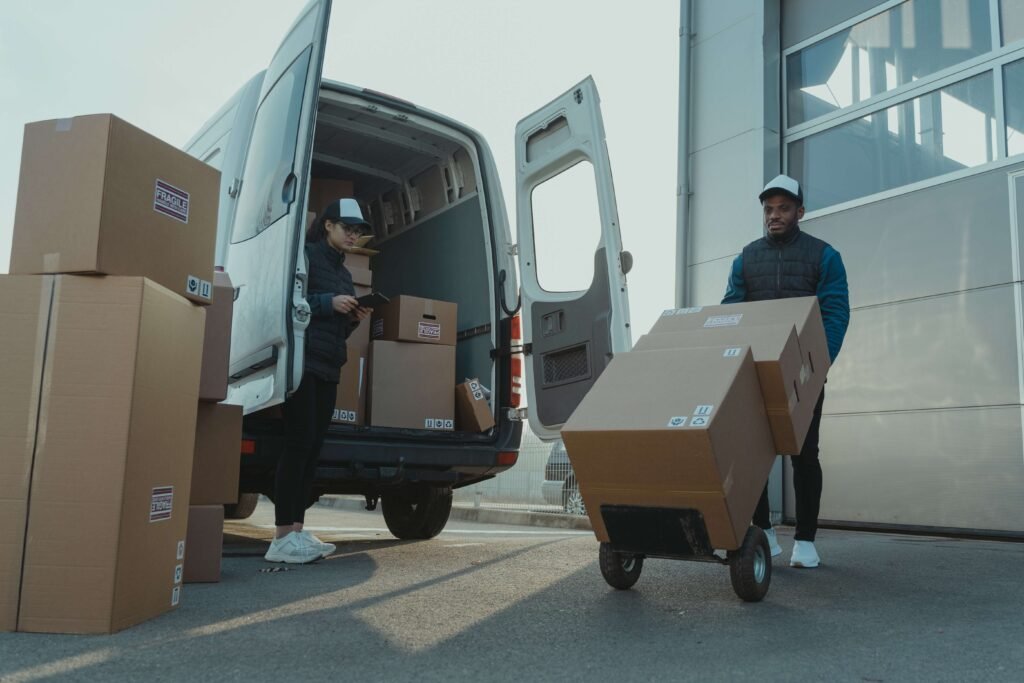
Orders for Pulse-managed projects leave our qualified manufacturing partner’s facility in neutral packing: plain, unprinted, with no transparent window and no artwork on the device or the pack. That is deliberate, and it is one of the first things buyers ask about, because custom vape packaging is part of the launch plan. Retail packaging belongs to you – designed by you, produced by your own packaging supplier – while we ship the hardware inside neutral packing. Here is where that line falls.
What is actually in the box when hardware ships?
Neutral packaging for vape hardware means exactly that: no printing, no artwork, no transparent window, no branding on the pack. Samples ship bagged and boxed so the units stay put in transit; production runs use standard foam trays – a top tray and a bottom tray – inside a standard carton. Nothing outside that carton says whose product it is, unless you ask us to put your shipping marks on it.
Brands sometimes send artwork and ask for it printed on the retail box. We do not print retail packaging – your supplier prints it, from artwork you own. What we hand over is the starting point: device dimensions, unit weight, pack-out numbers, and the product dieline drawing plus the outer box dieline drawings (single box and medium box), so your designer can place a logo and lay out the pack on real geometry instead of a guess. If a project needs it, we can recommend packaging suppliers or help you contact one.
Neutral factory packing vs custom retail packaging: who does what
The middle column is what we ship. The right column is your side of the line.
| Neutral factory packing (what we ship) | Custom retail packaging (your side) | |
|---|---|---|
| Outer box | Plain unprinted shipper, no artwork, no transparent window | Printed folding carton, rigid box or sleeve built to your dieline |
| Inner protection | Samples: bagged and boxed. Production: standard foam trays, top and bottom, inside a standard carton | Cut and formed to your retail unit: moulded pulp, EVA, PET or folded board |
| Label, barcode, batch fields | None applied | Your label, barcode and lot fields, in your layout |
| Artwork and dielines | Not our scope | Yours – you own the dieline and approve the print |
| Warning statements | Not printed on the neutral pack | Placed by you, on the panels your market requires |
| Printed insert or leaflet | Not supplied | Your copy and language set, your fold size |
| Child-resistant mechanism | Not built into the neutral packing | Structural work for your packaging supplier, with the test record |
| Tamper evidence and anti-counterfeit | Not applied | Your call: seal, hologram, scratch panel |
| Pack-out and shipping carton | Standard carton; weights and carton dimensions confirmed for you, and your shipping marks printed on the outer carton if you ask | Retail master carton with your SKU and shipping marks |
| Destination compliance on the pack | Not ours – pack text is a retail decision | Yours, including any claim printed on the pack |
| Who produces it | We do, in our factory, as part of the hardware order | Your packaging supplier, from the artwork you own |
Read the table as a boundary, not a limitation: the two halves are run by different people, and pack text approved by the wrong party is how launches slip.
Why is this split tied to who carries destination compliance?
Because packaging carries claims, and claims belong to whoever owns the product in the destination market. Our scope stops at the device and its neutral factory packing: hardware only – we do not supply or fill oil. Oil, formulation and the retail compliance of the finished product sit with the brand that puts it on the shelf.
That is also why the pack text is your decision. Warning statements, market-specific wording, label layout and anything printed as a claim are governed by your market and covered by your own legal advice. On the device side our position is fixed: Our hardware is designed for thick CBD distillate-style oils and is not suited to nicotine e-liquids.
One practical consequence: your pack copy is never cleared inside our production run, so the two timelines are independent. If retail packaging slips, the hardware does not have to wait – the units ship neutral.
What do you need to prepare before you brief a packaging supplier?
Six items. With all six, a packaging supplier can quote without questions.
- A dieline, not a render. A dieline gives fold lines, glue tabs and panel sizes; a render gives an impression and nothing a cutter can use. You do not start blank here – we supply the product dieline and the single-box and medium-box dielines as the base geometry.
- Device dimensions and pack-out. We confirm device dimensions, unit weight and quantity per carton. Pass those on, so the tray is cut to the real unit.
- Material and board. Board grade and thickness, and whether the pack is a folding carton, a rigid box or a sleeve with an insert.
- Surface finish. Matte or gloss lamination, soft-touch, spot UV, foil, emboss. Decide before the dieline is locked.
- Warning statement: wording, size, panel. Give the exact text and the panel you want it on, and mark which panels must stay clear of folds, tray edges and windows.
- Child resistance and anti-counterfeit. If child resistant vape packaging is required in your market, the structure is a packaging engineering decision, and the test record comes from whoever builds it.
When do you only need a new tray or a label?
Most cbd vape pen packaging decisions collapse into three cases, and only one of them needs a packaging supplier.
- Same device, new carton graphic. The dieline already fits the unit, so this is a print change on existing tooling.
- New tray or insert only. The carton is fine but the unit shifts inside it, or an accessory changed. A new insert die and a test fit usually settles it.
- Label only. White-label units with your label applied on your side, at your facility or by a contract packer. No packaging tooling at all.
Everything else – a new structure, a transparent display pack, a rigid box, a child-resistant closure – is a packaging supplier project. That is where it pays to tell us early: we hand over the dimensions and pack-out numbers your supplier needs, and if you have no packaging supplier yet, we can recommend one.
Where the common mistakes happen
Four of them, roughly in the order they surface.
- Artwork without a dieline. A quote is built from a rendering, then the panels do not line up with the folds once the dieline exists. Send the dieline and, if you have one, a plain white box sample.
- Transport ignored. A pack that looks right on a table can still let the unit shift in a loose fitment. Ask what happens when the carton is dropped, stacked or vibrated for a week in a container – a snug tray stops movement, not the outer box.
- Warning statement eaten by the structure. Text across a fold line, behind a tray edge or under a window is text nobody can read. Mark the safe panels on the dieline before print.
- Child resistance assumed instead of verified. A closure that works on an empty box may not close on a box holding the unit at production weight. Test with the real unit inside, and keep the record.
What should you send with your quote request?
Tell us the market you are selling into, the pack type, whether child resistance is required, your launch window, and whether a dieline already exists. Add the quantity per model and whether logo or voltage customisation is in scope.
You get the hardware side back in one pass: what we can confirm today, what depends on your packaging supplier, and where we can help. If you already work with a packaging supplier, name them – we will deal with them directly on dimensions.
What are the hardware terms behind a packaging question?
They do not change because the packing is neutral. MOQ is 3,000 pcs per model, production lead time 20-25 days after deposit confirmation, on 30% T/T deposit, 70% before shipment, priced EXW Shenzhen. Samples run on their own clock: blank samples in 2-3 days, units with custom voltage or logo in 5-7 days. Samples are charged and shipping is at the buyer’s cost.
Quality runs in three stages before a channel sees the product: 100 units to a US lab, 200 units to partner brands for real-oil testing, and 500 units through channel trial sales. On the device, the core is cotton-free porous ceramic with a three-hole intake, porosity 40-50% and pore size 20-40 µm, run at 1.8-3.1 V typical, with postless dual-airflow architecture on the D159 and D160 class.
The company behind the hardware is ShenZhen Pulse Technology Co., LTD, founded in 2020, with a core team of 10+ years in CBD vaporisation hardware. Background reading if the device is still open: why ceramic cores clog with thick CBD distillate, and how OEM, ODM and white label programmes differ.
If your retail packaging is already in progress, send us your dieline status and target quantity – we will confirm the hardware side and tell you which numbers your packaging supplier still needs. Request a quote and a sample and we reply within one business day. If you want the device in front of your packaging supplier first, review the hardware range and ask for a blank sample.