
A sample is not a result until you have tested it yourself. Buyers approve a device after drawing on units a supplier filled with a reference liquid, then meet different behaviour once their own distillate is inside. This guide covers the step that decides whether a cbd vape sample tells you anything: how to run the test, what to write down, and which readings count as a pass. It is written for brands placing a vape hardware sample order and running cartridge sample testing on their own bench.
Why does the sample have to be tested with your own oil?
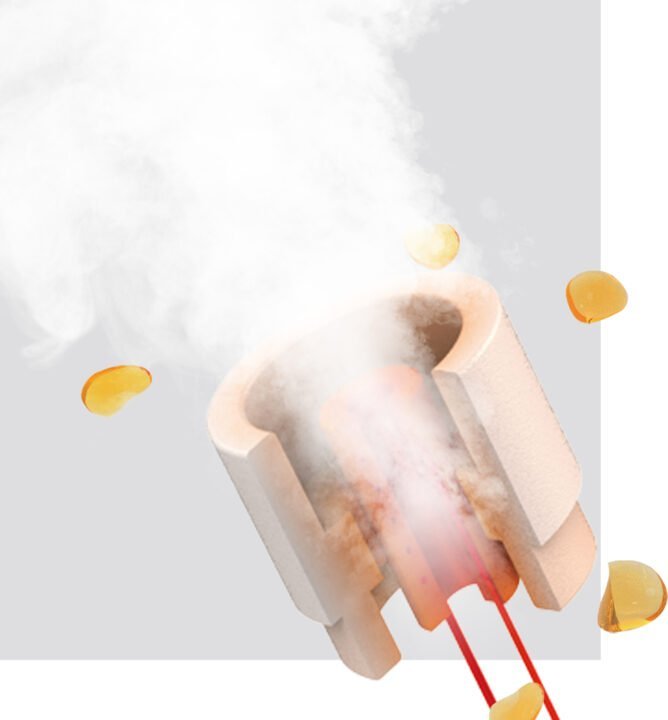
Because the core reacts to the oil, not to the device code. Our core is cotton-free porous ceramic with a three-hole intake, porosity 40-50% and pore size 20-40 µm. Those pores set how fast oil can refill the heating surface. Change the viscosity of the oil and you change that refill rate, which changes how the unit behaves at the same voltage.
Viscosity is not one number you can copy from someone else’s label. Two distillate-style oils can differ in winterisation, in how much terpene or other thinner was added, and in how they behave at 15 °C against 30 °C. A reference liquid that runs cleanly in our test room shows the device is assembled and working. It says nothing about your formula.
There is also a supply-side reason to fill your own units. hardware only – we do not supply or fill oil, so the blank units we send leave the oil, the fill volume and the compliance of the finished product with the brand. Your test is the first time your oil and our hardware meet, and that meeting is what you record.
The sample test record: what to observe and what looks normal
Copy the sheet below. Run three units of the same model at the voltage written on your sample confirmation, and keep a fourth aside unopened as a control. Note the oil batch, fill volume and room temperature at the top of every page.
| What to observe | How to test it | What looks normal | What looks like a problem |
|---|---|---|---|
| Draw count per fill | Fill with your own oil to the rated volume, draw 5 seconds with a 30 second gap until output fades, and count the draws | Output tapers gradually and the last third still produces vapour | Output collapses early, or the unit stops with oil still inside |
| Working voltage and preheat | Set the voltage band agreed for the sample and note how the first two draws behave from cold | Atomisation from the first or second draw, output steady across the fill | Nothing on the first draws, or a dry note straight after preheat |
| Clogging (airway tightening) | Judge draw resistance every 20 draws and write down the draw number where it changes | Draw stays close to the same across a full fill | Draw tightens steadily, or needs force to produce anything |
| Leaking | Stand the unit upright, then lay it on its side, and wipe the mouthpiece and air inlet at each check | Clean mouthpiece, dry contact, no marks in the pack | Oil at the mouthpiece, oil on the contact, oil marks on the packing |
| Burnt or dry taste | Taste rather than count: note the draw where the flavour changes character | Flavour holds to the end of the fill | A dry, sharp note before the fill is done |
| Draw resistance spread | Score each unit on the same 1-5 scale, then compare the three units | The three units score within one point of each other | One unit in the box clearly tighter or looser than the rest |
| Condensate build-up | After a full fill, look into the mouthpiece bore and the airway | A light film that wipes away | Pooled liquid, gurgling, or liquid reaching the mouth |
Write results as numbers or short notes, not as “good” or “bad”. “Draw resistance 3 at draw 20, 4 at draw 60, 5 at draw 110” is a finding you can act on. “Clogs” starts an argument with your supplier.
How do you simulate a cold start and a chain vape?
Your customer does not use the device the way a bench does. Two scenarios break a lot of samples.
Cold start. Put one unit somewhere cool overnight, then draw on it without warming it in your hand. Record whether the first two draws produce anything, and how many draws it takes before output is normal. Thick oil in a cold core refills slowly, and a unit that only works after five draws is a real finding for a winter market.
Chain vape. Take five draws of 3-5 seconds with 10-15 second gaps, and note the draw where flavour turns dry or output fades. A core that cannot keep up over several draws in a row will feel inconsistent in the field.
Warm ambient. If your market runs warm, repeat one fill with your oil at the warmest temperature the product will see. Oil thins as it warms, and the leak row is where that shows up.
What sample forms do we ship, and how fast?
We ship blank hardware, so the units arrive dry and ready for your oil fill. Our hardware is designed for thick CBD distillate-style oils and is not suited to nicotine e-liquids. Blank samples ship in 2-3 days, and units with custom voltage or logo take 5-7 days. Samples are charged and shipping is at the buyer’s cost. Tell us how many units your test cycle needs and at what fill volume, and we will confirm what can ship together.
Two settings are worth settling before you fill any unit with your own oil: the voltage band and the airway. On the D159 and D160 class the intake is postless dual-airflow and the band is 1.8-3.1 V typical. Ask for the band in writing on the sample confirmation, so your record sheet and the production run use the same setting.
How does your record connect to the three quality stages?
Before a channel sees the product, quality runs in three stages – and they are ours, not yours — once per model, before we offer it —100 units to a US lab, 200 units to partner brands for real-oil testing, and 500 units through channel trial sales. Your record is a separate baseline: the same observations, taken on the first units you tested, are what you compare later batches against. What those stages look like on the floor, with the packing data from a real shipment, is set out in Inside the Factory.
So write the record even when the result is good. “It seemed fine” gives a lab nothing to check, while a draw number gives the next batch something to hit.
The first ten minutes with a new sample
Do this before you fill any unit with your own oil, while the units are still boxed.
- Count against the packing list. Note what arrived against what the confirmation said, including spare units.
- Check the code on the units. The model and the voltage marking should match what you ordered. A wrong band is cheap to correct now and expensive after a full fill test with your own oil.
- Look for oil or residue. Blank hardware should arrive dry. Oil or dust on the mouthpiece, fill port or contact is a note for us before you test.
- Weigh one unit dry, then again after you fill it with your own oil. That tells you how much oil actually went in against the rated volume.
- Set the standing time. Give the unit you filled with your own oil time to wick before the first draw, and record how long you allowed. If that first draw is dry, the standing time is part of the result.
- Write the header fields. Date, oil batch, fill volume, room temperature, unit IDs. Ten minutes here saves a rewrite later.
If the record raises a question you cannot answer from the bench, the mechanics of wicking are covered in why ceramic cores clog with thick CBD distillate, and where our scope ends is set out in the hardware-only model.
What should you send back with your record?
Send the sheet as it is, including the rows that failed, plus the oil details you can share, the fill volume, the temperature range you tested in, and photos of any leak or condensate. If the test points at a change, say which one: the airway, the voltage band, or the fill port.
Terms do not depend on the test result. MOQ is 3,000 pcs per model, production runs 20-25 days after deposit confirmation, on 30% T/T deposit, 70% before shipment, priced EXW Shenzhen. If retail packaging is part of your plan, the split between neutral factory packing and your own retail pack is worth reading before you brief a designer.
The hardware comes from ShenZhen Pulse Technology Co., LTD, founded in 2020, with a core team of 10+ years in CBD vaporisation hardware.
Tell us the model, the oil type you are testing and the fill volume, and we will confirm the sample plan and the voltage band in writing. Request a quote and a sample and we reply within one business day. If you would rather settle the device first, ask for a blank sample before you commit to an oil fill test.