
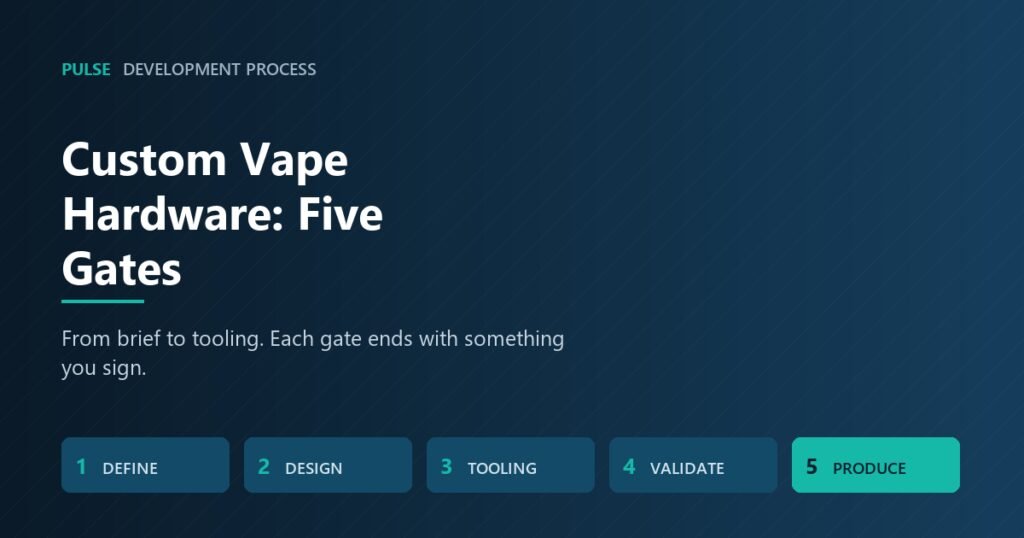
A custom hardware project is built from approvals, not parts. It runs through five gates: define, design, tool and check first articles, validate, then produce. Each gate ends with something you sign. Each gate can also send the project back a step. The two costly mistakes both happen when a gate is skipped: approving tooling before your oil is tested, and changing the spec after tooling exists.
The five gates at a glance
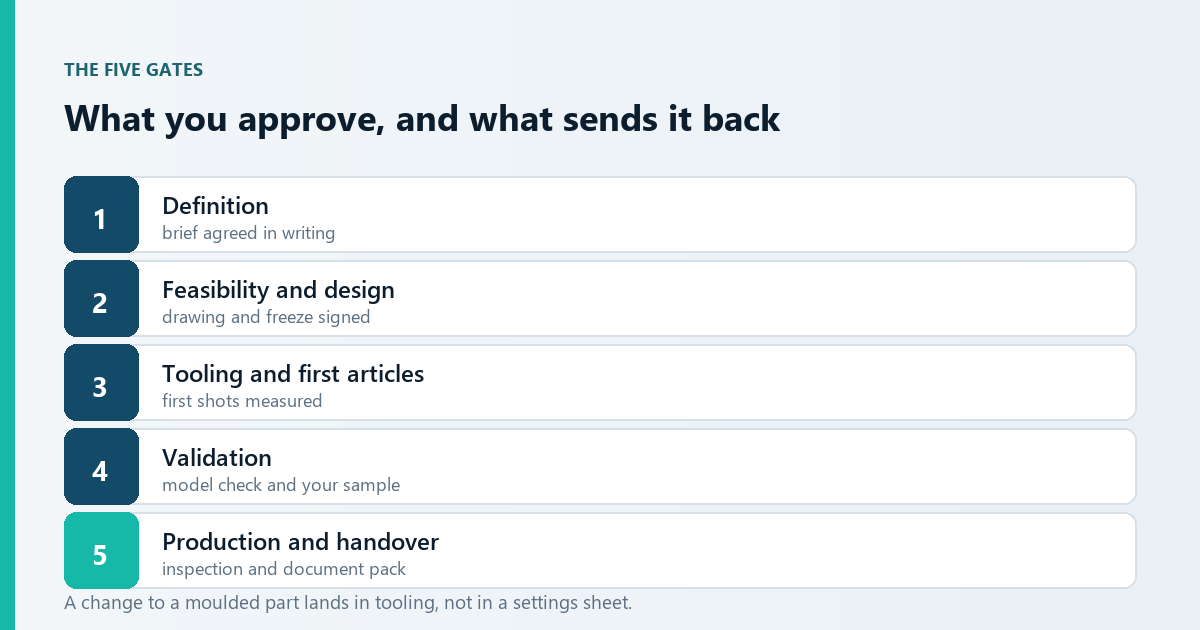
| Gate | You approve | We produce | What sends it back |
|---|---|---|---|
| 1. Definition | The brief: format, capacity, oil behaviour, fill volume, voltage band, airflow, quantity | A written project definition and a proposed direction | An open question about fill volume, oil or market temperature |
| 2. Feasibility and design | The drawing and the design freeze | Engineering review, part list, tooling plan, materials | A change to a moulded part after the drawing is signed |
| 3. Tooling and first articles | First articles measured against the drawing | Tooling, first shots, dimensional check | First articles that miss the drawing, or a late design change |
| 4. Validation | The model check record and your sample test | Three-stage model check, per-unit electrical test | A failed stage, or oil that behaves differently from the sample |
| 5. Production and handover | The inspection result and the document pack | Production, packing, carton marking, export documents | A document that does not match the order |
The gates run in order for a reason. Each one removes a different kind of uncertainty. Money spent before the uncertainty is removed tends to be spent twice.
Gate 1: definition — the brief is a spec
Most slow projects are not slow to make. They are slow to define. A vague brief gets a vague proposal, and the questions come back later, when they cost more. A brief that can be built without a follow-up question answers six things.
Format and capacity. Disposable or 510-format, and the fill volume. Our range runs from 0.5 ml to 5.0 ml across more than twenty models, and the capacity for a given model is confirmed in your quotation. Which of those models you are buying under — OEM, ODM or white label — is a separate decision from the gate sequence below.
Your oil, described by behaviour. Not a brand name. How it moves at room temperature, whether it needs warming to fill, and how it behaves in a cool room.
Draws per fill and voltage band. On our hardware the working band is typically 1.8-3.1 V and is customizable.
Airflow intent. Fixed or adjustable, and roughly how open the draw should feel.
Quantity. Our MOQ is 3,000 pcs for a first order.
Who carries what. We supply empty hardware. Oil, filling and destination compliance stay with you.
Write the brief down and have both sides agree it. A brief that lives only in a chat thread is not a gate.
Gate 2: feasibility and design — the drawing you will be held to
Here the question changes from what you want to what can be built. Three things get settled.
Which parts change. Changing the mouthpiece and the artwork is a small project. Changing the tank, the airway and the battery is not. Each changed moulded part is a tooling item. Ask for the part list, and ask which parts are new.
Who owns the design and the tooling. On our own models we own the product design, our own tooling (private moulds) and the component supply chain. The design is developed in-house and is not licensed to other manufacturers. On an OEM project where you bring the drawing, who owns the drawing and the tooling made for it is a contract term. Write it here, not after the first articles arrive.
What the freeze covers. Dimensions, material, airflow geometry and the voltage band. Your artwork and your retail packaging are not in it. Those sit on your side: custom retail packaging is designed and produced by your own suppliers. Mixing them into the hardware freeze is how projects get stuck.
Gate 3: tooling and first articles
Tooling sets the shape of the device. Time depends on how many parts are new, and how hard they are to cut. Ask for it in writing against your own part list. A supplier who quotes one tooling duration for every project is quoting a slogan.
When first articles arrive, check them against the drawing, not against a photo. Check the size, the fit, the airflow path, the bore, and the values on the sample confirmation. This is the moment to fill a unit with your own oil, because the hardware and the oil meet here for the first time.
Sample timing on our side: 2-8 days, 5-7 days with paid logo printing, and blank white-label units can go to your nominated forwarder in 2-3 days. A sample tested with a reference liquid only proves the device is assembled. Test the sample with your own oil.
Gate 4: validation — the model is qualified, your order is not
This gate is misunderstood often, so it is worth stating plainly. On our side, quality runs a three-stage check on each new model, once, before the model is offered. First 100 units go to a US lab. Then 200 units to partner brands for real-oil testing. Then 500 units through channel trial sales. Once per model — not once per order. It is not repeated for the orders that follow.
That is different from the per-unit test on the line. On the line, each unit goes through electrical testing before it moves on. Before shipment the order is checked against model, colour and quantity. Both are true at the same time. A supplier who describes only one of them is describing half a quality system.
One limit shapes what validation can mean. We cannot legally test with controlled cannabinoid formulations inside China. Our in-house work runs on pure VG, and the customer validates their own formulation on the samples we send. The model check proves the platform. Your sample test proves the pairing.
Gate 5: production and handover
Production lead time is 20-25 days for a standard order with custom branding. Very large volumes take longer, and the number should come back against your actual quantity. Payment is 30% T/T deposit to start production and 70% before shipment. The price term is EXW Shenzhen. The order sequence that follows approval — how a first order runs — is set out separately.
Packing is part of the handover. Factory packing is neutral and unprinted. Custom retail packaging comes from your own suppliers. Master cartons are marked so the shipment can be checked before it leaves.
Documents belong here too. Battery shipments travel with UN38.3 test reports and an MSDS/SDS for the cell actually used. The paperwork is issued against the exact device and cell combination in your order. We welcome third-party pre-shipment inspection and will provide the China Tobacco Monopoly Production Enterprise Licence and the battery transport documents for your verification on request. Regulated mass production and export are executed by qualified manufacturing partners holding applicable licences.
Change control: the gate that never closes
Every project gets one late change. The question is where it lands. A change to artwork lands in your packaging supplier’s schedule. A change to the airway or mouthpiece lands in tooling. A change to the voltage band lands in the sample confirmation, and sometimes in a re-test. Name the change, the part it touches, and who pays for the revision. That is the difference between a two-week slip and a restart. Record it with the date and the person who approved it.
FAQ: custom hardware development
How long does a custom hardware project take?
It depends on how many parts are new. Samples are 2-8 days, or 5-7 days with paid logo printing. Production for a standard order with custom branding is 20-25 days. Tooling time is quoted against your own part list. A project that changes one part is not a project that changes five.
Do I own the drawing and the tooling?
On our own models, the design and the tooling are ours, and the design is not licensed to other manufacturers. On an OEM project where you bring the design, ownership of the drawing and of the tooling made for it is written into the project agreement at the design gate. Ask for that sentence before tooling starts, not after.
Can we skip samples and go straight to production?
No. The sample is where your oil meets the hardware, and the model check does not test your formulation. Skipping that step moves the discovery into the production run, where a finding costs a full order instead of a sample pack.
Who handles FDA, customs and destination compliance?
Compliance for the filled product and for the destination market stays with you. We supply empty hardware and the documents that belong to the hardware and the shipment. We are not the importer of record, and we do not give classification or regulatory advice for your market.
What if my first order is below 3,000 pieces?
Our MOQ is 3,000 pcs per model for a first order. Below that, the project does not have a production slot. We would rather say so at Gate 1 than discover it at Gate 5.
Where this fits what we do
Pulse owns product definition, R&D, industrial and structural design, hardware engineering, ceramic-core selection, tooling and customization, OEM/ODM project management, supply-chain coordination, quality management, and export project coordination. Production is executed by qualified manufacturing partners in Shenzhen. If you are commissioning a device rather than picking a catalogue item, send the brief described at Gate 1. You will get a reply within one business day with a proposed direction and the questions that remain open.