
Four choices decide whether a filled device behaves with your oil: how the core is built, how much air the intake lets in, how much heat the voltage band puts in, and how much oil it holds. This guide shows how to choose vape hardware for your oil in the order that saves samples.
Short answer. Choose vape hardware for your oil by the oil’s viscosity band, not by the device style you like. In the high band, ask for a more open feed path, a wider or adjustable intake, a preheat step and a smaller fill volume. In the low band, ask for a tighter feed path, a smaller intake, a lower working voltage and a fill volume your draw count supports. Write the four choices down and confirm them on your own oil before you approve a sample.
Step 1. How to choose vape hardware for your oil: start with the band
Viscosity belongs to your oil, not the device, and it moves with temperature, so a number without its temperature cannot be compared with anything.
At room temperature, watch a sealed sample:
- Band 1, free-flowing. Runs as a stream and levels in seconds.
- Band 2, slow. Leaves a film; levels in tens of seconds.
- Band 3, stiff. Does not level; warm it before it flows.
An oil in Band 2 in a warm room behaves like Band 3 in a cold warehouse. Our hardware is engineered for thick CBD distillate and is not suited to nicotine e-liquids.
Step 2. Choose pore size and porosity as one pair
Pore size and porosity are quoted as two numbers and bought as if independent. They are not: in the ideal capillary relation, flow scales with the fourth power of the radius, so wider pores feed faster.
Porosity sets how much oil the core holds. Two working combinations:
- High porosity with small pores. Holds more oil and releases it slowly.
- High porosity with wider pores. Releases faster and holds less against the heating surface.
Standard single-bore cores sit around 40-50% porosity with 20-40 micron pores: the typical range for that type, not our figure.
Our core is a tri-channel ceramic body: a central channel houses the heating element, and two side channels carry oil and equalise pressure. It runs at 55% ± 5 porosity with 8 micron pores: a small pore with high porosity and several oil paths. Test that pair on your oil with the sample test record.
Step 3. Set the intake with the feed path, not after it
The intake sets how hard the user pulls, and it helps pressure equalise as the device is filled and capped.
- Low band. A tight feed with an open draw lets a user pull thin oil quickly, so keep the intake smaller.
- High band. The user pulls against a slow feed, so a wider or adjustable intake lets them take the draw they expect. On our D159 and D160 the intake is postless with dual airflow.
Selected models use a 1.8-2.0 mm four-hole intake; others are fixed. If the draw tightens over a fill, the finding belongs to the airway and the condensate: airflow, resistance and leakage.
Step 4. Match voltage to the band and to the start of the draw
Voltage and resistance are one decision. Resistance is set per model, 0.8-1.2 ohm across our current range. Working voltage is typically 1.8-3.1 V and is customizable. The heater is a nickel-chromium wire inside the core, and oil is drawn to it through the ceramic.
- Preheat is a start-of-draw tool. It gets stiff oil moving off a cold core; ask for the model’s designed value.
- Working voltage is a running tool. Raising it does not make oil reach the core faster, it makes the core hotter; if the feed path is too tight, more heat adds harshness, not flow.
Step 5. Size the fill volume last, against the band and the draw count
Capacity is the decision buyers make first and should make last. Our range covers 20+ models from 0.5 ml to 5.0 ml; capacity for a given model is confirmed in your quotation.
Feed distance sets the ceiling: in a larger fill the oil travels further, and the last third is where a marginal feed path shows. The draws you expect per fill matter too: a stiff oil in a large fill asks more draws of a slow path.
If symptoms appear at the end of a fill, reduce the fill volume for that band.
How to choose vape hardware for your oil: the selection matrix
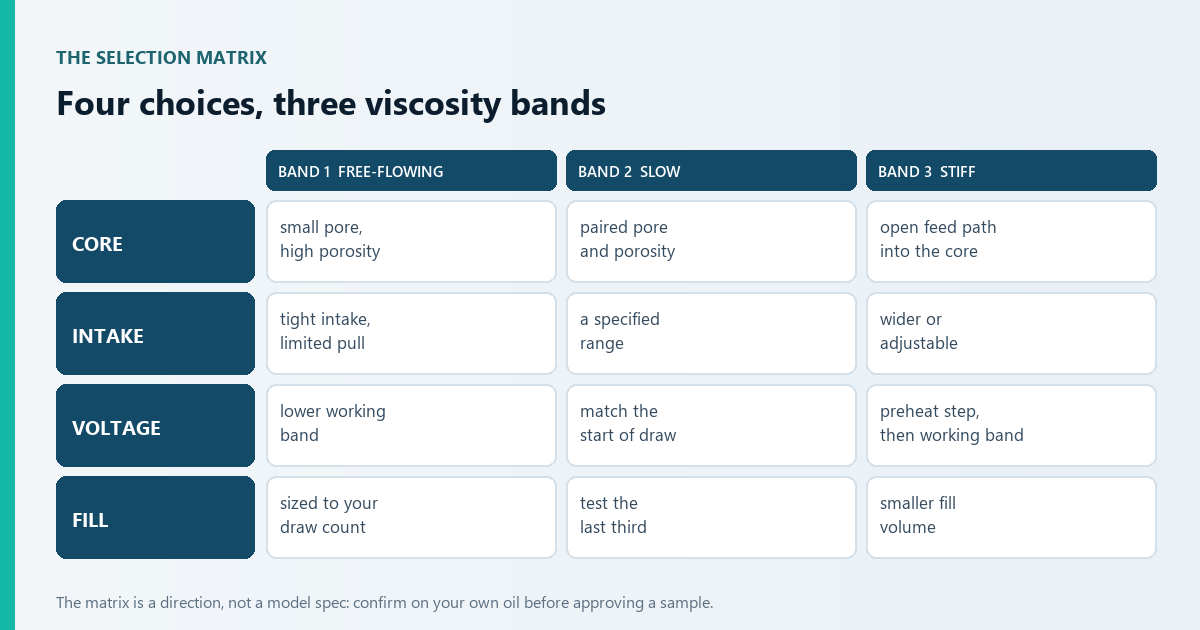
| Viscosity band | Core: pore + porosity + paths | Intake | Voltage and preheat | Fill volume |
|---|---|---|---|---|
| Band 1, free-flowing | Tighter feed: smaller pore at moderate to high porosity, or fewer oil paths; fix the pair in writing. | Smaller fixed intake. | Lower working band within the model’s range; preheat short or absent. | Small to mid, sized to the draws per fill. |
| Band 2, slow | The pair is the experiment: state pore and porosity, change one variable at a time. | Mid intake; adjustable if the range spans Band 1 or 3. | Mid working band; preheat only if a cold first draw is reported. | Mid; keep it constant between samples. |
| Band 3, stiff at room temperature | More open feed: wider pore, higher porosity, or more oil paths; our tri-channel body uses two side channels plus the centre. | Wider or adjustable intake; check where air enters against the heating surface. | Preheat at the top of the designed range, then a working band that holds. | Smaller fill for the same draw count; in a cold market, treat the oil as one band higher. |
What a mismatch looks like: symptoms and the lever to move
Symptoms, not numbers, are the guide here. Match the observation to one lever, change it, test again.
| What you observe | Which lever is usually wrong | What to change first |
|---|---|---|
| Dry or harsh first draw after standing | Feed path too tight, or no preheat | Ask for a preheat value, or open the feed path |
| Harsh or weak in the last third of a fill | Fill volume too large | Reduce fill volume for that band |
| Gurgling, spit, or oil at the mouthpiece | Feed or intake too open, or voltage too high | Tighter intake and feed pair; lower working band |
| Vapour falls when the user pulls harder | Intake too small for the band | Wider or adjustable intake |
| Oil at the contact, or a leak after a temperature drop | Pressure path, rated fill volume, or a closed intake | Check the pressure path and rated volume first |
If a symptom survives one change, the next layer is the core and oil mechanism: why ceramic cores clog with thick distillate covers it.
What to send us so the recommendation fits your oil
Six inputs turn this page into a specification: the band or measured value with its temperature; the formulation notes and what carries the oil; fill volume and draws per fill; your market’s temperature range; fixed or adjustable airflow; and which decisions stay with you. Scope: empty vape hardware only. We do not supply, fill or sell oil, nicotine or e-liquid.
We work as the product development and OEM/ODM partner. Pulse owns product definition, R&D, industrial and structural design, hardware engineering, ceramic-core selection, tooling and customization, OEM/ODM project management, supply-chain coordination, quality management, and export project coordination. Regulated mass production and export are executed by qualified manufacturing partners holding applicable licences.
Every new model goes through a three-stage quality check once, before we offer it; it is not repeated for the orders that follow. Each unit goes through electrical testing before it moves on, so per-unit testing and per-model qualification are different things. Which commercial model you buy under, OEM, ODM or white label, is a separate decision. Send the six inputs through the quote form. You will get a reply within one business day.
FAQ
What counts as thick oil for vape hardware?
No single number works, and a number without a temperature is not usable. Describe your oil at the temperature you measured it: free-flowing, slow, or stiff at room temperature. Send any measured value with its temperature, spindle and speed.
Should I choose the widest pore for my thick oil?
Pore size is one lever of three. Flow is sensitive to radius, but porosity sets how much oil the core holds and how many paths feed the heating surface. A wide pore with one path and a small pore with high porosity and several paths are different design points; ask for the pair and test your oil.
Will a higher voltage fix a thick oil?
It heats the core more; it does not make oil reach the core faster. On a stiff oil a preheat step helps the start of a draw, inside the range designed for the model, typically 1.8-3.1 V. If the feed path is too tight, more heat adds harshness, not flow.
Can one device cover two oils in my range?
Only if both oils fall in the same band at your market’s temperature. If one is Band 1 and the other Band 3, fix the specification per oil, or choose adjustable airflow and a preheat step and accept a per-SKU fill volume.
What happens if I put a stiff oil in a large fill?
The symptom arrives at the end, where the oil has furthest to travel and fewest draws left. Test the last third explicitly; if it fails, the first correction is a smaller fill volume, not a hotter heater.