
If you are a US brand or distributor asking how to import empty vape hardware into the US, the work sits on your side of the border, not the factory’s. Five jobs decide whether your shipment clears. (1) Name your importer of record. (2) Get the entry filed in ACE. (3) Understand how FDA reviews the entry line. (4) Prepare the lithium battery transport file, and (5) keep every document telling the same story. This page covers entry and admission. For China-side commercial terms, see our China-side import guide.
1. Name your importer of record first
The importer of record (IOR) is the party CBP holds responsible for the entry. CBP puts it plainly: even when you use a broker, you, the importer of record, are ultimately responsible for the correctness of the entry documentation presented to CBP and for all applicable duties, taxes and fees (CBP, Tips for New Importers and Exporters).
Do you need a customs broker?
CBP licenses customs brokers, and licensed brokers are not CBP employees (CBP, Customs Brokers). Many importers file through one; others file their own entry. Decide before you place a purchase order, because your broker’s questions shape the documents you ask your supplier for.
Two practical rules:
- Introduce your broker to the product early. Send the model list, packing data and battery documents weeks before the ship date.
- Ask for the classification in writing, before production starts.
Pulse is a hardware supplier. We are not a customs broker, and we do not declare your shipment.
2. Get the entry filed in ACE
ACE — the Automated Commercial Environment — is CBP’s import and export processing system (CBP, ACE). Entries are filed there electronically, usually by your broker.
Your entry line carries classification, value, quantity, origin and agency data. Classification is your broker’s call, not ours. Whether your goods are entered as a complete device or as a part turns on what they are as presented at the border and how they will be used. Two official tools your broker will use are CBP’s Customs Rulings Online Search System (CROSS) and the Harmonized Tariff Schedule published by the US International Trade Commission.
We do not quote duty rates or landed cost. Your broker calculates those.
3. Understand how FDA reviews your entry line
This is the part US buyers discover too late. “Empty” is not the test FDA applies.
FDA’s tobacco program treats electronic nicotine delivery systems as including components and parts. Import Alert 98-07 is titled “Detention Without Physical Examination of Electronic Nicotine Delivery Systems (ENDS) Lacking Premarket Authorization”, and its definition of ENDS expressly includes components and parts (FDA, Import Alert 98-07).
That alert is a DWPE alert: FDA field staff may detain a shipment without physically examining it. FDA’s own announcement states that any unauthorized e-cigarette product offered for import may be subject to detention without physical examination and refused admission — and that a pending application is not a legal safe harbor (FDA announcement on the updated import alerts).
What FDA asks for on the entry line
FDA publishes a filing resource for ENDS entries, listing the data FDA needs:
- Government Agency Program Code: TOB
- A processing code — Consumer Use / CSU, For Further Manufacturing / FFM, or Investigational / INV
- The product code
- The tobacco submission tracking number (TST), where one applies
- Separate entry lines when products differ in any characteristic, including brand name or flavor
- A specific description. FDA’s own example warns against a general term such as “atomizer”
See FDA, Information for successfully filing entries of ENDS products.
Accessories versus components
FDA’s deeming rule brought products meeting the definition of a tobacco product under its tobacco authority, with accessories of deemed products excluded (FDA, Importing Tobacco Products). Where a part ends and an accessory begins is a question of design, description and intended use. Put that question to your broker, and to FDA’s import office if it matters. Not to your supplier.
Check the lists yourself
FDA publishes its tobacco import alerts by industry and a searchable database of authorised products. Open them yourself. No supplier’s assurance — ours included — replaces the primary source.
A note on TTB
The Alcohol and Tobacco Tax and Trade Bureau (TTB) comes up whenever the word “tobacco” appears on a form, but its remit covers alcohol and specific tobacco categories. Whether it touches your entry line is for your broker.
One caution about our own language: when Pulse says “empty vape hardware only”, we describe what we supply. That is not a legal opinion about jurisdiction over your shipment, and it is not a substitute for your broker’s review.
4. Build the lithium battery transport file
Every disposable pen has a lithium-ion cell inside, so air carriers treat the shipment as dangerous goods. Two documents come from our side, and one decision belongs to your forwarder.
From Pulse, with the paperwork issued against your order:
Battery shipments travel with UN38.3 test reports and an MSDS/SDS for the cell actually used.
Battery paperwork is issued against the exact device and cell combination in your order.
Note the limit in the first sentence: the reports cover the cell actually used in your build, not a generic family.
Your forwarder then decides which transport rules apply. The set usually includes a UN38.3 test summary, an SDS, the lithium battery mark and, sometimes, a Shipper’s Declaration for Dangerous Goods. Which packing instruction applies depends on whether the cells are contained in equipment or packed with it, and small cells may qualify for the lighter “Section II” provisions. The instruction in force is the one in the current IATA Dangerous Goods Regulations (IATA, Batteries).
An SDS is not a UN38.3 test summary. They are two different documents, and forwarders ask for both. Why hardware-only shipments still need them is covered in Battery paperwork and customs.
5. Make every document agree with every other
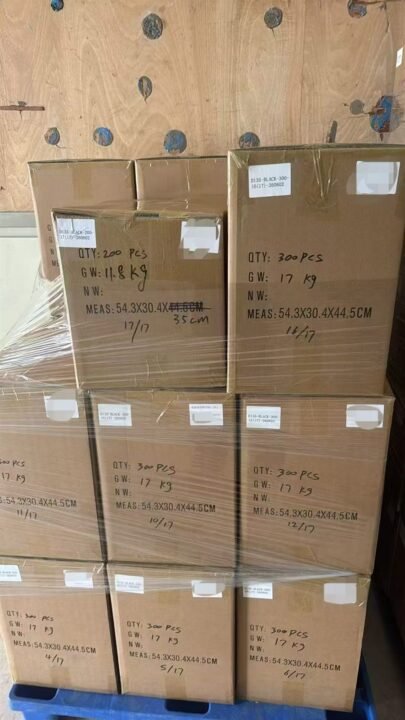
Four documents travel with the goods: the commercial invoice, the packing list, the air waybill or bill of lading, and the certificates. They must agree on model, quantity, carton count, gross weight and watt-hours per unit.
Most port delays we see are not caused by a missing document, but by two documents that disagree: an invoice listing three models while the cartons hold four; a watt-hour figure that changes between revisions.
Describe the goods the same way everywhere. The workable description is short: empty vape hardware, no liquid, no nicotine, plus the model. Accuracy is the goal, not a loophole. A label does not change which agency has jurisdiction over the goods. We cover the hardware-only model in more depth in Hardware-only CBD vapes.
What we can pass to your broker
Once an order is confirmed we provide the documentation your customs broker needs, and the authorisation your logistics provider requires to declare the shipment.
We also welcome third-party pre-shipment inspection (SGS, QIMA, V-Trust) and will provide the China Tobacco Monopoly Production Enterprise Licence and the battery transport documents for your verification on request.
On material and quality documents, our position is narrow: quality-management, cleanroom and material documentation — ISO 9001, ISO 13485 / GMP, RoHS / CE / FDA food-grade, heavy-metal screening — sits with the individual factories that hold it, and we pass on the copies they release for your file.
For heavy metals specifically:
Material quality and safety come first. We use screened materials and test for heavy metals with reference to the limits applied under California and Michigan regulations, and finished units are checked before packing rather than assumed clean.
RoHS, REACH and similar material-level documents are issued by the factory or material supplier that holds them; we forward them when a customer needs them. The same applies to UL and IEC reports: they belong to the party that holds them, not to us.
Two more points. Our scope is empty vape hardware only — we do not supply, fill or sell oil, nicotine or e-liquid. Our factory packing is neutral and unbranded; custom retail packaging is designed and produced by your own suppliers, and we can refer packaging partners we work with.
Before you book freight: a short checklist
- Importer of record named, and your broker engaged.
- Model list final, with quantities, carton counts and gross weights.
- Classification requested from the broker in writing.
- Battery file requested from us and handed to your forwarder.
- FDA entry data agreed — TOB, the processing code, the product code and the TST.
- One description used on every document: empty vape hardware, no liquid, no nicotine, plus the model.
- FDA’s own lists opened and read.
The bottom line
Importing empty vape hardware into the US is a sequence of decisions you own: who imports, how the entry is filed, how FDA reads the entry line, what travels with the batteries, and whether your documents agree. Your broker decides classification and duty. FDA decides admission. Your job is to give both of them a clean, consistent file — and to start that file before the goods leave Shenzhen.